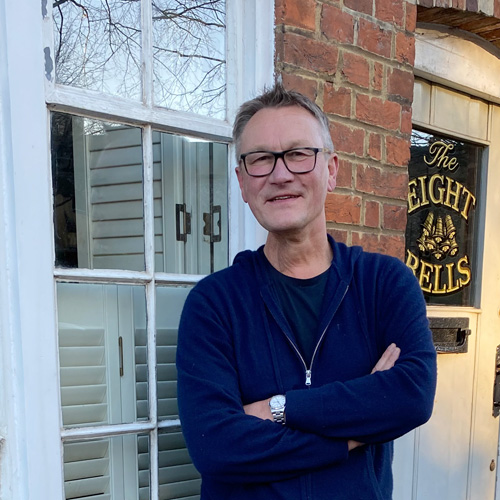
About Mark Clark
What is your artistic background and training?
From early school years I was passionate about art and an artist was all I wanted to be. I left school after my first year of 6th form as I was offered a place at St Alban’s Art College for a two year foundation course. This also enabled me to finish my A Level.
From there I went to Loughborough College of Art and Design to complete my three year degree. My degree was in painting although initially I was going to specialise in sculpture which is a medium which I still love to this day.
I was then offered a place to do my three year post-graduate degree in Painting at the Royal Academy Schools in Piccadilly, which was always the place I had dreamed of studying, because my main focus in my artistic development is the human form. At the RA Schools for the first two years I worked exclusively from a life model. For my final year I specialised in print-making, taught by the renowned Royal Academician Norman Ackroyd.
I exhibited at the Royal Academy Summer Exhibition every year for over 25 years, displaying my prints, drawings and paintings. In 1998 the renowned art critic Frank Whitford especially praised my strong draughtsmanship in my etchings at the Summer Exhibition on the gallery text panels, describing my nudes as “technically amazing”. In 2008 I was nominated as a candidate to become a Royal Academician in print-making. This was such a tremendous honour for me having Royal Academicians I had admired for so long considering me worthy enough to become one of their peers.
I was invited to exhibit a nude print in the London Print Fair again at the Royal Academy of Arts. Even though I have had many one-person shows in Mayfair and Chelsea, this single display I feel is one of my proudest moments, being hung next to my artistic heroes including Picasso, Degas, Rembrandt and Matisse.
What themes or concepts do you explore in your art?
My art focuses on the human figure and people that I have met and seen through my extensive travels in India. I love the colour and intensity of India, particularly the vibrancy and majesty of Rajasthan and Gujurat. I have visited India over 20 times and never cease to find new inspiration. From the cities of Delhi, Agra, Udaipur and Kolkatta, down to the beautiful Keralan backwaters and the Chinese fishing nets of Kochi.
The other element of the human form that fascinates and inspires me is working from life. It has been with me all through my artistic life from my first experience as a 15 year-old school boy attending my first life class. It is ever changing. I can work from one person’s face or body from a certain angle and the next time I can discover a completely different feeling, mood or energy. Often I am drawn to working in the chiaroscuro technique; the dramatic play of light and dark, particularly inspired by Carravaggio.
How would you describe your artistic style or technique?
I am known for my draughtsmanship and detailed technique, my use of colour, light and shade.
My medium of choice, if I had to pick one, would be charcoal, again from my earliest days it has been an ever-present tool. If I am particularly struggling, I turn to charcoal. I love the immediacy of it and the richness of the blacks to the delicacy of a light touch. I also love the fact that it is hard to erase so you have the honest process that comes through. This may not always be apparent in my more recent drawings but behind the detail is the freedom of expression and truth when first putting charcoal to a blank piece of paper.
More recently I have discovered pan pastels where the medium is applied with a sponge. This particularly highlights the process of building up layers. Starting loosely can be viewed on the time-lapse videos on my website, how it develops into the finished piece.
In the last ten years I have moved away from print-making to focus entirely on painting and drawing. One of my unusual painting techniques is oil on copper because my etchings were exclusively on a copper surface. Once the edition run is finished the etched image can no longer be used. After viewing some small Rembrandt paintings on copper, this inspired me to use my old copper plates. Due to the surface, it’s luminosity and ability to enhance intimate detail, this medium lends itself particularly well to my Indian works. The way the copper shines through reflects the wonderful light and vibrant colours particularly of the people and landscapes of Rajasthan.
Another interesting technique I have recently discovered is the ancient drawing practice known as silverpoint. This historic method was popular during the Middle Ages and Renaissance using a sharp metal stylus, usually silver, drawn across a specially prepared surface such as gesso to leave a faint, indelible line of metal. The lines cannot be erased. I am still at the early stages of exploring this medium. It is extremely delicate, so soft, and lacks the tonal range so is almost the antithesis of chiaroscuro. The image has a particularly different quality I am really enjoying. I find its gentle quality really lends itself to drawing faces.
What drives or inspires your work and what do you hope it will convey?
“For me drawing is the fundamental basis of all art. From my early days of just trying to capture the model as accurately as possible, in my later student years my drawing became much more gestural, heavily influenced by Frank Auerbach. As my work developed, while I still start in a loose way, my work becomes more and more refined. I sometimes work quickly but one could almost say my technique has come full circle by becoming as accurate as possible whether a a figure in a landscape, a portrait or nude, whether from afar or portrait commission close up.
“I hope that people see my artwork and enjoy the techniques and mediums I use. But more than that, my wish is that the people who admire or buy my work, every time they look at one of my pieces, on their wall, in an exhibition or online, they will see more and more in the detail and the expression.”
As the Art historian and retired Museum Director Tom Freudenheim wrote:
“Mark Clark’s amazing work is both wonderfully evocative and exceptionally skilled. His draughtsmanship is so breathtaking that one might momentarily forget this is really art. But not because he is a photorealist. Far from it, Clark’s images, especially the Indian series, are sensitive and caring portrayals of people with whom one becomes acquainted. An initial encounter is seductive as art, but then there’s the subsequent feeling that one knows – or wants to know – who these people are. So one is left hovering between a beautiful image in art (like Vermeer’s Girl with the Pearl Earring) and a biographical impulse. That’s not the case with Clark’s sensitive delicate figure studies, but they, too, shimmer with a life of their own.”
Another of my clients wrote:
“I bought my first Mark Clark work, a beautiful nude, in 2000. Not a day goes past when I don’t look at it with the same pleasure as the day it became mine. They say that beauty is in the eye of the beholder but, given the amount of lovely comments friends have made, I know I am not the only person who thinks that Mark’s ability to capture a moment in time is extraordinary.”